Tips for Homeowners - "People still mistakenly assume they are covered for floods under their standard homeowner policies. That might explain why only 9% of homeowners in the West have flood insurance, according to industry estimates."
Tips For Homeowners:
Flood Insurance, El Nino, & You
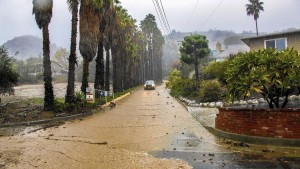
Mud flows down Hicrest Road during heavy rain in Glendora earlier this month. Flood insurance covers mudflow damage, but homeowners and the National Flood Insurance Program sometimes differ on what qualifies as a mudflow. (Irfan Khan / Los Angeles Times)
As El Nino Continues, Do You Know What You're Insured For?
As we move deeper into winter, we've had one hit from El Nino so far and are expecting more. At this time, no one knows the current status of El Nino, but we're all looking for the latest El Nino update, that's for sure. All over Southern California and the San Gabriel Valley, people are preparing as best they can for the possibility that we might face some of the El Nino conditions that have led to property damage and even loss of life during previous El Nino years. We all want to be prepared as best we can.
It's times like this that people start to think about flood insurance. Sad to say, it's times like this that are among the only times people actually do think about this kind of coverage. Worse still, when people do think about it, most discover that they really have no idea what type of damage they are covered for and what type they would have to handle on their own. Believe it or not, most homeowners still operate under the incorrect impression that their Homeowner's Insurance policy covers them for flood. They are sadly mistaken.
When a home is purchased using a federally insured loan, such as a VA or FHA loan, the lender will require a flood insurance policy if the property is situated within a federally mapped flood area. These areas are mapped by the Federal Emergency Management Agency (FEMA), and there are about 236,000 policies inforce in California today. Most of these were purchased through the National Flood Insurance Program which was established by Congress in 1968. The huge majority of the homes insured for flood are within these FEMA mapped districts. However, as we learned in our last El Nino, you don't need to be in a FEMA flood zone to suffer severe flood damage.
Even with flood insurance, there are caveats to be aware of. Most policies may cover flood but, at the same time, may not cover mud flows. When investigating what a policy covers and what it doesn't, it's possible to get all fouled up and lost in the weeds trying to decide the definition of "flood", "mud flow", "dirty water intrusion" ... the nomenclature seems endless.
The bottom line here is that most folks don't know enough about their own coverage or about flood insurance in general. FEMA has been running a publicity campaign urging homeowners at risk to purchase flood insurance policies. There has been a recent surge in policies sold in California. Still, as a group, homeowners are woefully uninformed on the subject.
Here's a really informative article by Matt Stevenshfrom the L.A. Times. It provides a complete rundown and some good advice.
"Experts have warned that this winter's El Niño could generate flooding, mudflows and landslides. But the entire spectrum of storm-related damage is not covered by homeowner insurance or even flood insurance. In general, experts say damage from falling water is covered by homeowner insurance whereas damage from rising water requires flood insurance. The National Flood Insurance Program says it covers "direct physical loss" caused by "flood," which it defines as "an excess of water on land that is normally dry." Damage from what FEMA calls "mudflows" — rivers of liquid and flowing mud — is also covered by flood insurance. But FEMA distinguishes between mudflows and what the agency calls "moving saturated soil masses" that go down a slope without "a flowing characteristic."
"Some things are very straightforward," said Ahsha Tribble, a regional FEMA administrator. "Some things have a bit of a gray area." ..."
The best advice we can give you, if you're concerned about possible damage to your property from flood-related events during this El Nino season is to talk to your insurance agent and get a real rundown on just what you're covered for and what you're not. Flood insurance is not necessary for everyone, and there are many holes in coverage if you do have it. However, not knowing if you need it or what you're covered for if you get it is a prescription for disaster. As in all things: do your due diligency. Don't guess at your situation. Take the time to know where you stand, so you can protect your home, your investment, yourself, and your family.
Tips for Homeowners
This cookie is used to distinguish between humans and bots.
session
spbc_is_logged_in
Dashboard. Flag defines if a user was logged in.
Session
spbc_firewall_pass_key
The flag defines if the Security Firewall was passed.
Session
spbc_cookies_test
Cookie to test cookies so we know that everything working properly
Session
ct_sfw_
Group of cookies used for our SpamFireWall technology.
Session
ct_
Group of cookies used for storing dynamic variables from browser
Session
apbct_
Group of cookies which are set from backend and contain information about the current user
Session
apbct_cookies_test
?ookie to validate other cookies, so they can’t be spoofed.
Session
ct_timezone
Used in order to detect spam and improve the website's security.
Session
ct_ps_timestamp
Used in order to detect spam and improve the website's security. Does not store visitor specific data.
session
ct_pointer_data
Used in order to detect spam and improve the website's security. Does not store visitor specific data.
session
ct_fkp_timestamp
Used in order to detect spam and improve the website's security. Does not store visitor specific data.
session
ct_check_js
Used in order to detect spam and improve the website's security.
session
apbct_antibot
This cookie is used to distinguish between humans and bots. This is beneficial for the website, in order to make valid reports on the use of their website.
session
spbc_2fa_passed
Dashboard. Flag defines if Two-Factor Authentication was passed.
Session
spbc_log_id
Dashboard. User identification.
Session
spbc_timer
Dashboard. Time spent on the page.
Session
These cookies are needed for adding comments on this website.
Name
Description
Duration
comment_author_url
Used to track the user across multiple sessions.
Session
comment_author
Used to track the user across multiple sessions.
Session
comment_author_email
Used to track the user across multiple sessions.
Session
Statistics cookies collect information anonymously. This information helps us understand how visitors use our website.
Google Analytics is a powerful tool that tracks and analyzes website traffic for informed marketing decisions.
Contains information related to marketing campaigns of the user. These are shared with Google AdWords / Google Ads when the Google Ads and Google Analytics accounts are linked together.
90 days
__utma
ID used to identify users and sessions
2 years after last activity
__utmt
Used to monitor number of Google Analytics server requests
10 minutes
__utmb
Used to distinguish new sessions and visits. This cookie is set when the GA.js javascript library is loaded and there is no existing __utmb cookie. The cookie is updated every time data is sent to the Google Analytics server.
30 minutes after last activity
__utmc
Used only with old Urchin versions of Google Analytics and not with GA.js. Was used to distinguish between new sessions and visits at the end of a session.
End of session (browser)
__utmz
Contains information about the traffic source or campaign that directed user to the website. The cookie is set when the GA.js javascript is loaded and updated when data is sent to the Google Anaytics server
6 months after last activity
__utmv
Contains custom information set by the web developer via the _setCustomVar method in Google Analytics. This cookie is updated every time new data is sent to the Google Analytics server.
2 years after last activity
__utmx
Used to determine whether a user is included in an A / B or Multivariate test.
18 months
_ga
ID used to identify users
2 years
_gali
Used by Google Analytics to determine which links on a page are being clicked
30 seconds
_ga_
ID used to identify users
2 years
_gid
ID used to identify users for 24 hours after last activity
24 hours
_gat
Used to monitor number of Google Analytics server requests when using Google Tag Manager