Southern California Home Sales - "Southern California home prices increased at a slower pace in April as inventories improved and investor purchases waned, a research firm said Tuesday. " ...
Southern California Home Sales:
Price Rise Slows As Inventory Grows
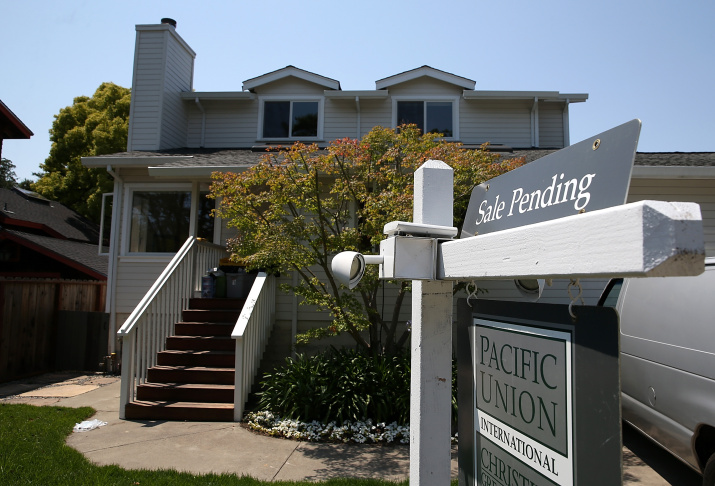
SAN ANSELMO, CA - JULY 02: A sale pending sign is posted in front of a home for sale on July 2, 2013 in San Anselmo, California. Southern California home prices increased at a slower pace in April as inventories improved and investor purchases waned, a research firm said Tuesday. (Photo: Justin Sullivan/Getty Images)The "Investor Frenzy" Calms A Bit
In looking at the most recent reports of last month's market activity here in the Southern California Home Sales market, we find that the ongoing rise in prices slowed a bit as inventories grew. We can also see that the "frenzy" of investor purchases seems to be slowing a bit as well.
The Southern California area is showing a marked increase in the number of properties available when compared with last year. This is a reflection of the rising values, which have made it possible for some who wanted to sell but couldn't ... because they were still "upside down" in their property values ... to actually enter the market this year. If the inventory continues to increase as we move into summer, that would make it a lot easier for the market to reach "average" activity levels ... which we haven't really seen in several years now.
Here's an article from the Associated Press, as it appears on the KPCC - Southern California Public Radio website:
The median sales price for new and existing single-family homes and condominiums was $404,000, up 1 percent from $400,000 in March and up 13.2 percent from $357,000 in April 2013, DataQuick said. It was the 25th straight month that the median sales price rose from a year earlier but the lowest annual percentage increase since September 2012. ...
A "calm" market is a more stable market. We've been watching activity for a long time now that is more common to a "volitile" market than a stable one. However, market activity always fluctuates in "waves". Periods of volatility are usually generated as markets search for a position of stability. If we can see a continuation of the increase in the size of the market inventory, and a bit of a pull-back in investor activity, this would encourage a slow-down of rising prices, a bit more welcome competition, and a more attractive market for the "average" resident home buyer. With that type of situation in place, we could be looking at a summer that just might return the Southern California real estate market to a more "traditional" footing.
This cookie is used to distinguish between humans and bots.
session
spbc_is_logged_in
Dashboard. Flag defines if a user was logged in.
Session
spbc_firewall_pass_key
The flag defines if the Security Firewall was passed.
Session
spbc_cookies_test
Cookie to test cookies so we know that everything working properly
Session
ct_sfw_
Group of cookies used for our SpamFireWall technology.
Session
ct_
Group of cookies used for storing dynamic variables from browser
Session
apbct_
Group of cookies which are set from backend and contain information about the current user
Session
apbct_cookies_test
?ookie to validate other cookies, so they can’t be spoofed.
Session
ct_timezone
Used in order to detect spam and improve the website's security.
Session
ct_ps_timestamp
Used in order to detect spam and improve the website's security. Does not store visitor specific data.
session
ct_pointer_data
Used in order to detect spam and improve the website's security. Does not store visitor specific data.
session
ct_fkp_timestamp
Used in order to detect spam and improve the website's security. Does not store visitor specific data.
session
ct_check_js
Used in order to detect spam and improve the website's security.
session
apbct_antibot
This cookie is used to distinguish between humans and bots. This is beneficial for the website, in order to make valid reports on the use of their website.
session
spbc_2fa_passed
Dashboard. Flag defines if Two-Factor Authentication was passed.
Session
spbc_log_id
Dashboard. User identification.
Session
spbc_timer
Dashboard. Time spent on the page.
Session
These cookies are needed for adding comments on this website.
Name
Description
Duration
comment_author_url
Used to track the user across multiple sessions.
Session
comment_author
Used to track the user across multiple sessions.
Session
comment_author_email
Used to track the user across multiple sessions.
Session
Statistics cookies collect information anonymously. This information helps us understand how visitors use our website.
Google Analytics is a powerful tool that tracks and analyzes website traffic for informed marketing decisions.
Contains information related to marketing campaigns of the user. These are shared with Google AdWords / Google Ads when the Google Ads and Google Analytics accounts are linked together.
90 days
__utma
ID used to identify users and sessions
2 years after last activity
__utmt
Used to monitor number of Google Analytics server requests
10 minutes
__utmb
Used to distinguish new sessions and visits. This cookie is set when the GA.js javascript library is loaded and there is no existing __utmb cookie. The cookie is updated every time data is sent to the Google Analytics server.
30 minutes after last activity
__utmc
Used only with old Urchin versions of Google Analytics and not with GA.js. Was used to distinguish between new sessions and visits at the end of a session.
End of session (browser)
__utmz
Contains information about the traffic source or campaign that directed user to the website. The cookie is set when the GA.js javascript is loaded and updated when data is sent to the Google Anaytics server
6 months after last activity
__utmv
Contains custom information set by the web developer via the _setCustomVar method in Google Analytics. This cookie is updated every time new data is sent to the Google Analytics server.
2 years after last activity
__utmx
Used to determine whether a user is included in an A / B or Multivariate test.
18 months
_ga
ID used to identify users
2 years
_gali
Used by Google Analytics to determine which links on a page are being clicked
30 seconds
_ga_
ID used to identify users
2 years
_gid
ID used to identify users for 24 hours after last activity
24 hours
_gat
Used to monitor number of Google Analytics server requests when using Google Tag Manager