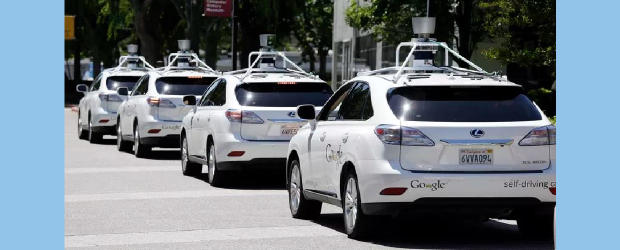
In just a few years, driverless cars have gone from a far-off, futuristic vision to a near certainty.
A row of Google self-driving Lexus cars at a Google event outside the Computer History Museum in Mountain View, Calif. AP Photo/Eric Risberg, File
Yesterday I posted some information about how the advent of driverless cars might effect the price of rural real estate. While I was researching that I came across this really interesting article from Curbed. It's about how autonomous cars could completely re-design our cities. This is amazing stuff!
According to the experts referenced in the story everything from the size of our roads to the need for garages to be included with homes could change. Think about it. Imagine huge commercial fleets of autonomous cars available at any time. You set up a contract for you and 3 neighbors to be picked up at a certain time and driven automatically to work. You no longer need to store an auto on your property, and your drive time can become work time. When you begin to think about it, the repercussions go on forever.
This means huge shifts in our daily commute, but it also has the potential to dramatically reshape our cities. Cars—their size, reach, and environmental impact—have been a huge factor in urban planning and development over the last century. A world where driverless cars are prevalent, and shared vehicle ownership is the norm, offers a chance to rethink and reconsider the design of our urban environment. Curbed spoke with five transportation and urban design experts and asked them to speculate on how this potential future of transportation, arriving soon under its own guidance, may reshape the cities we live in.
This story asked five experts to speculate on the kinds of changes we could see in our cities and our lifestyle with the advent of autonomous vehicles. Read the Complete Story Here.: Click for more
This cookie is used to distinguish between humans and bots.
session
spbc_is_logged_in
Dashboard. Flag defines if a user was logged in.
Session
spbc_firewall_pass_key
The flag defines if the Security Firewall was passed.
Session
spbc_cookies_test
Cookie to test cookies so we know that everything working properly
Session
ct_sfw_
Group of cookies used for our SpamFireWall technology.
Session
ct_
Group of cookies used for storing dynamic variables from browser
Session
apbct_
Group of cookies which are set from backend and contain information about the current user
Session
apbct_cookies_test
?ookie to validate other cookies, so they can’t be spoofed.
Session
ct_timezone
Used in order to detect spam and improve the website's security.
Session
ct_ps_timestamp
Used in order to detect spam and improve the website's security. Does not store visitor specific data.
session
ct_pointer_data
Used in order to detect spam and improve the website's security. Does not store visitor specific data.
session
ct_fkp_timestamp
Used in order to detect spam and improve the website's security. Does not store visitor specific data.
session
ct_check_js
Used in order to detect spam and improve the website's security.
session
apbct_antibot
This cookie is used to distinguish between humans and bots. This is beneficial for the website, in order to make valid reports on the use of their website.
session
spbc_2fa_passed
Dashboard. Flag defines if Two-Factor Authentication was passed.
Session
spbc_log_id
Dashboard. User identification.
Session
spbc_timer
Dashboard. Time spent on the page.
Session
These cookies are needed for adding comments on this website.
Name
Description
Duration
comment_author_url
Used to track the user across multiple sessions.
Session
comment_author
Used to track the user across multiple sessions.
Session
comment_author_email
Used to track the user across multiple sessions.
Session
Statistics cookies collect information anonymously. This information helps us understand how visitors use our website.
Google Analytics is a powerful tool that tracks and analyzes website traffic for informed marketing decisions.
Contains information related to marketing campaigns of the user. These are shared with Google AdWords / Google Ads when the Google Ads and Google Analytics accounts are linked together.
90 days
__utma
ID used to identify users and sessions
2 years after last activity
__utmt
Used to monitor number of Google Analytics server requests
10 minutes
__utmb
Used to distinguish new sessions and visits. This cookie is set when the GA.js javascript library is loaded and there is no existing __utmb cookie. The cookie is updated every time data is sent to the Google Analytics server.
30 minutes after last activity
__utmc
Used only with old Urchin versions of Google Analytics and not with GA.js. Was used to distinguish between new sessions and visits at the end of a session.
End of session (browser)
__utmz
Contains information about the traffic source or campaign that directed user to the website. The cookie is set when the GA.js javascript is loaded and updated when data is sent to the Google Anaytics server
6 months after last activity
__utmv
Contains custom information set by the web developer via the _setCustomVar method in Google Analytics. This cookie is updated every time new data is sent to the Google Analytics server.
2 years after last activity
__utmx
Used to determine whether a user is included in an A / B or Multivariate test.
18 months
_ga
ID used to identify users
2 years
_gali
Used by Google Analytics to determine which links on a page are being clicked
30 seconds
_ga_
ID used to identify users
2 years
_gid
ID used to identify users for 24 hours after last activity
24 hours
_gat
Used to monitor number of Google Analytics server requests when using Google Tag Manager