
Los Angeles Commercial Real Estate Is Already Feeling the LA28 Effect
Los Angeles commercial real estate is already beginning to reflect the business, infrastructure and development impact of the 2028 Olympic and Paralympic Games.
The opening ceremony is still nearly two years away, but 2028 is no longer a distant date for property owners, investors, tenants or developers. Olympic-related organizations are leasing office space. Media operations are being assigned to major studio campuses. LAX is pushing forward with terminal and roadway modernization. Inglewood is moving through an extraordinary run of international sports and entertainment events. Across the region, public agencies and private owners are making decisions with a fixed global deadline in view.
The more useful question, however, is not whether the Olympics will “change Los Angeles.” It is where the Games will accelerate trends that were already underway—and which of those changes can create durable value after the crowds leave.
That distinction matters. LA28’s current venue plan is unusual by Olympic standards because organizers plan to use existing stadiums, arenas and other facilities rather than build new permanent competition venues. The commercial real estate story is therefore less about a new Olympic district rising from the ground and more about how existing districts, transportation systems, hospitality assets, office buildings and entertainment infrastructure adapt to a huge temporary surge in global attention.
For investors, that creates opportunity—but it also creates a reason to be selective.
Where LA28 Could Move Los Angeles Commercial Real Estate
A global event creates something ordinary real estate cycles rarely provide: a highly visible deadline. Roads, terminals, transit connections, hospitality capacity, event operations and visitor-facing improvements cannot simply be finished “eventually.” July 2028 is coming whether individual projects are ready or not.
That deadline can accelerate capital spending and decisions that might otherwise take longer. Urban Land Institute Los Angeles has already framed airport expansion, transit connectivity, restaurants, workforce housing and small-business participation as part of the built-environment conversation surrounding the Olympics and other major events coming to the region.
But acceleration does not mean every nearby property automatically becomes more valuable. The properties most likely to benefit are those connected to long-term demand patterns that the Games intensify rather than create from nothing.
Downtown Los Angeles: Olympic Demand Meets a Difficult Office Market
Downtown Los Angeles remains one of Southern California’s most complicated office stories. Vacancy is high, hybrid work has permanently changed tenant behavior, and many older buildings still face fundamental questions about repositioning, conversion, or obsolescence.
That is precisely why recent Olympic-related leasing is worth watching.
On Location LA, the premium hospitality provider working on the 2028 Games, leased 108,272 square feet across six floors at 445 S. Figueroa Street for its Los Angeles headquarters and Olympics hospitality operations. CBRE described it as the largest new Downtown Los Angeles office lease since the fourth quarter of 2024.
One lease does not rescue the Downtown office market. What it does show is that large, event-driven organizations still place a premium on well-capitalized Class A buildings, central locations, strong amenities and access to transit, dining and entertainment.
For Los Angeles commercial real estate owners, the lesson is broader than the Olympics. In a market with too much undifferentiated office space, quality and relevance matter. A building that can serve a sophisticated tenant with specific operational needs is competing in a different market from a building that is merely available.
The Olympics may therefore widen the gap between stronger office assets and buildings that still lack a convincing reason for tenants to choose them.
Inglewood: More Than a Stadium Story
Inglewood may be the clearest example of why investors should separate the Olympics from the larger transformation surrounding them.
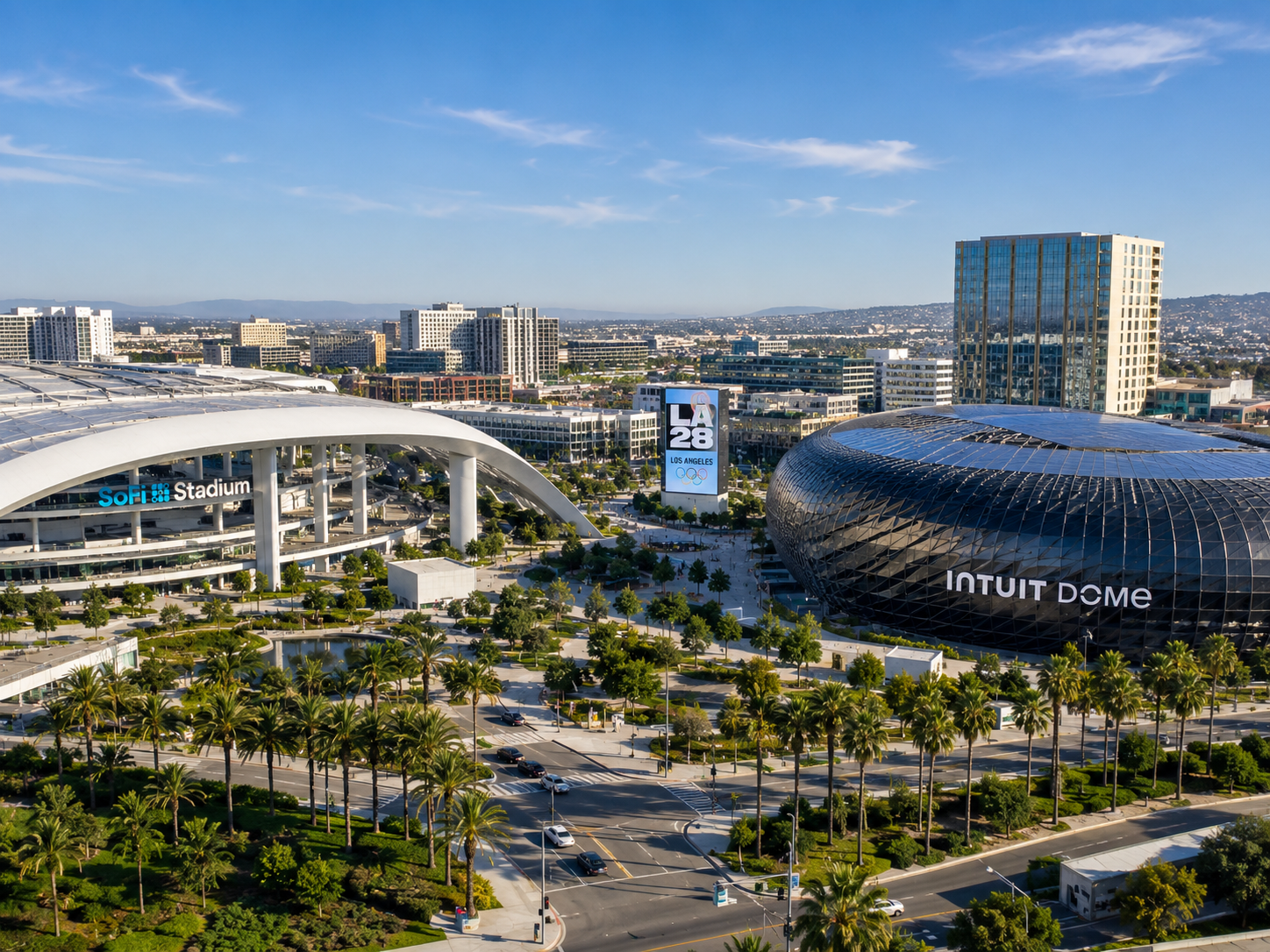
SoFi Stadium, the Kia Forum, Intuit Dome and the broader Hollywood Park development were not created solely for LA28. The city’s evolution into a major sports and entertainment center was already well underway. But the sequence of the 2026 FIFA World Cup, the 2027 Super Bowl and the 2028 Olympic and Paralympic Games gives that transformation an extraordinary three-year global spotlight.
LA28’s current venue plan places major Olympic functions in the Inglewood Zone, including basketball, swimming and ceremony activity. In July 2026, organizers also confirmed that Hollywood Park Studios will support Main Press Center functions and other media operations during the Games.
That kind of activity reaches beyond ticketed venues. Broadcasters, production crews, sponsors, hospitality operators, vendors, visitors and corporate partners all need places to work, stay, eat, meet and move.
For nearby retail, restaurant, hotel, office and service properties, the key question is whether event-driven traffic helps establish habits and businesses that remain viable after 2028. The strongest investment case is not “millions of people are coming for the Olympics.” It is “the area is becoming a stronger year-round destination, and the Olympics are accelerating that process.”
The 2028 Olympics in Los Angeles Are Also a Media Real Estate Story
One of the more interesting—and distinctly Southern California—parts of LA28 is the amount of real estate required to show the Games to the world.
LA28 announced in July that two studio campuses will play major roles in Games-time media operations. Hollywood Park Studios in Inglewood will support the Main Press Center and related production functions. Warner Bros. Studios’ Ranch Lot in Burbank will house the International Broadcast Center, the global operational headquarters for media-rights holders.
That is significant because these are not temporary tents on an empty site. They are part of Southern California’s existing and expanding entertainment-production ecosystem.
The Ranch is expected to operate for Olympic broadcasting for several months before, during and after the Games. Hollywood Park Studios, meanwhile, is part of the larger Hollywood Park master development. The use of major studio infrastructure for Olympic media reinforces the value of specialized real estate that combines production capability, technology, power, connectivity, security and large-scale operational flexibility.
For commercial investors, the broader takeaway is that “Olympic real estate” does not necessarily look like a stadium. In Los Angeles, it can look like a studio campus, a Class A office floor, an airport concession, a hotel, a restaurant corridor or a transportation-adjacent property.
LAX and Transportation: The Legacy May Matter More Than the Event
Some of the most durable real estate effects may come from infrastructure that remains long after 2028.
Los Angeles World Airports is in the middle of a multi-billion-dollar transformation of LAX. Terminal 4 modernization reached a major construction milestone in May 2026. Terminal 5 is being replaced, with reopening planned just before the Olympics.
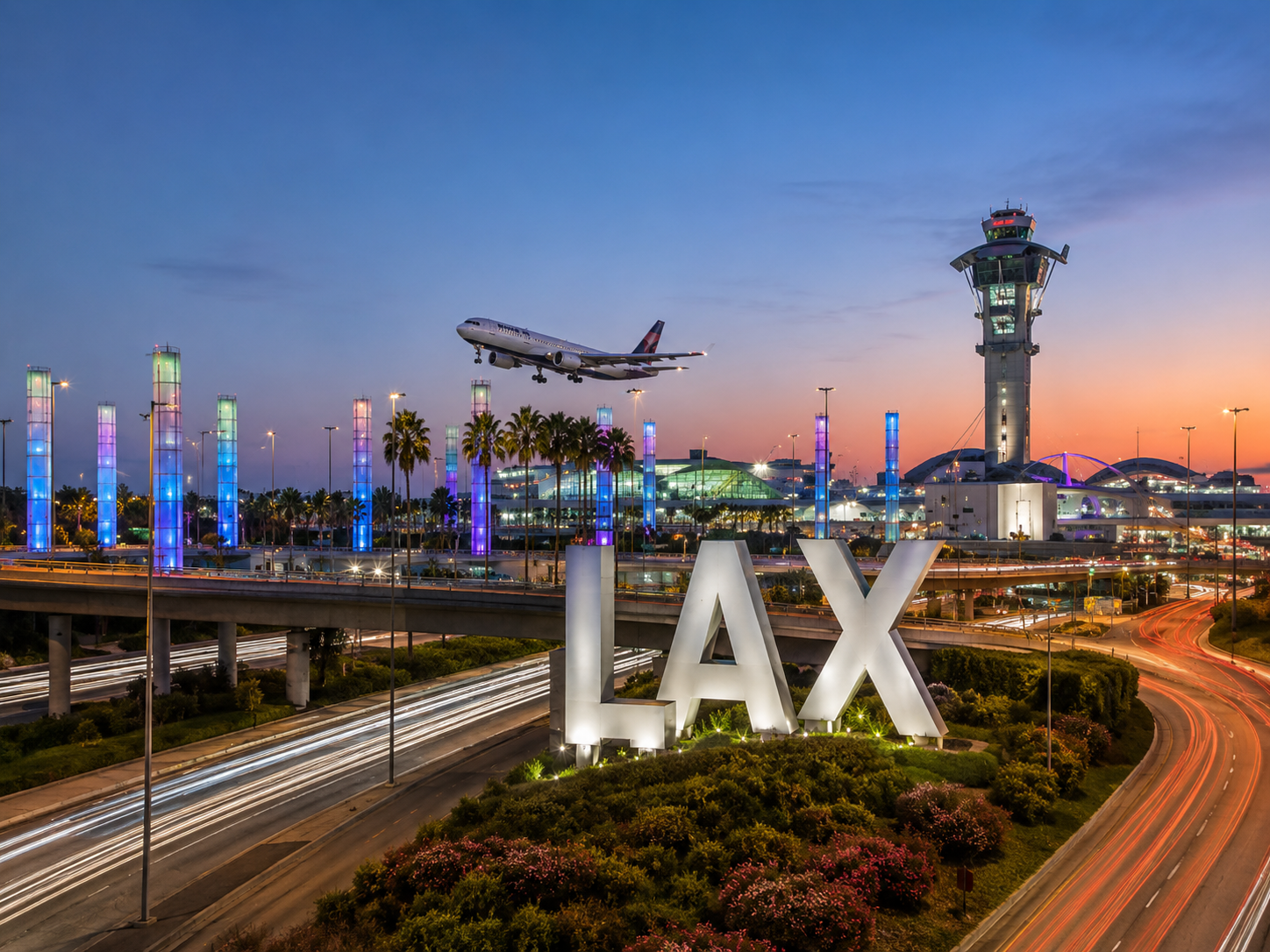
The Tom Bradley International Terminal is also being refreshed, while major roadway work is intended to improve access into and around the airport.
The Olympics did not originate every one of these projects. Some were planned years earlier. But the Games have become an important delivery deadline and a reason to focus intensely on the visitor experience.
That distinction is important for underwriting. Investors should be cautious about paying for a short-lived event premium, but infrastructure that permanently changes accessibility can alter the long-term usefulness of surrounding commercial property.
Better airport access, more reliable transportation connections and improved movement between major activity centers can affect hotels, industrial and logistics properties, retail, office locations and mixed-use development long after the final medal ceremony.
What Los Angeles Commercial Real Estate Investors Should Watch Before 2028
As the Games approach, Los Angeles commercial real estate investors should resist the temptation to treat “Olympics proximity” as an investment thesis by itself.
A better approach is to ask several harder questions.
- Is the demand permanent or temporary? A hotel that performs because of a two-week event is very different from a hotel in a location whose tourism and entertainment demand is strengthening for a decade.
- What happens when the Olympic premium disappears? Any acquisition that only works under unusually aggressive 2028 assumptions deserves another look.
- Is infrastructure genuinely improving the property’s accessibility? A nearby public project is not automatically an investment thesis.
- Can the asset adapt? Buildings with flexible layouts, modern systems, strong power capacity, useful parking or transit access and multiple potential tenant profiles are better positioned for an uncertain post-2028 market.
- What does the cost side look like? Hospitality and other labor-intensive sectors face significant operating-cost pressures, while insurance, financing and construction expenses remain important Southern California underwriting variables.
- What is the acquisition basis? Global events attract enthusiasm, and enthusiasm can make buyers accept assumptions they would normally challenge. The Olympics can improve a location without making every price rational.
No New Olympic Park May Be the Point
There is a larger strategic idea behind LA28 that may ultimately matter to real estate investors.
Organizers say the Games will be the first Olympics in 80 years not to require construction of new permanent competition venues. Los Angeles already has an unusually deep inventory of stadiums, arenas, universities, entertainment facilities and other venues.
That changes the legacy question.
Instead of asking what happens to a newly built Olympic park after 2028, Los Angeles can ask how an enormous international event can make better use of assets and districts that already exist.
That approach fits an important commercial real estate principle: value is often created not by building the newest thing, but by making an existing asset more useful, more connected and more relevant to current demand.
The same logic applies to owners evaluating their own properties. An aging office building may need repositioning. A retail property may benefit from a changing visitor corridor. A studio facility may gain value because of technology and production infrastructure. A hotel may become more attractive because transportation improves around it.
The Olympics do not eliminate the need for disciplined underwriting. They make disciplined underwriting more important.
The Opportunity Is in the Legacy, Not the Headlines
The 2028 Olympics in Los Angeles will generate enormous attention, but attention and investment value are not the same thing.
For owners and investors, the most interesting opportunities are likely to appear where LA28 accelerates a change that already has economic logic: stronger destination districts, improved transportation, modernized hospitality, high-quality office demand, specialized media infrastructure and properties that can serve multiple uses after the Games.
That is why the next two years are worth watching closely. Los Angeles commercial real estate is entering a period in which public infrastructure, private capital, entertainment, tourism and global events are converging on the same calendar.
The winners will not necessarily be the properties closest to an Olympic venue. They will be the assets whose value proposition is stronger in 2029 than it was before the Olympic flame arrived.
Brion Costa, CCIM
Broker Associate, Commercial Director
Century 21 Adams and Barnes
626-695-7385
DRE#: 00939864